If you’ve been looking for a price on forestry mulching, you’ve probably noticed that very few companies post one. That’s because two properties with the same acreage can take very different amounts of time to mulch, and the size of the lot is rarely what decides it.
Below is what moves the price of a mulching job around Louisville and the surrounding counties, so you know what we’re looking at when we walk your property.
What forestry mulching is
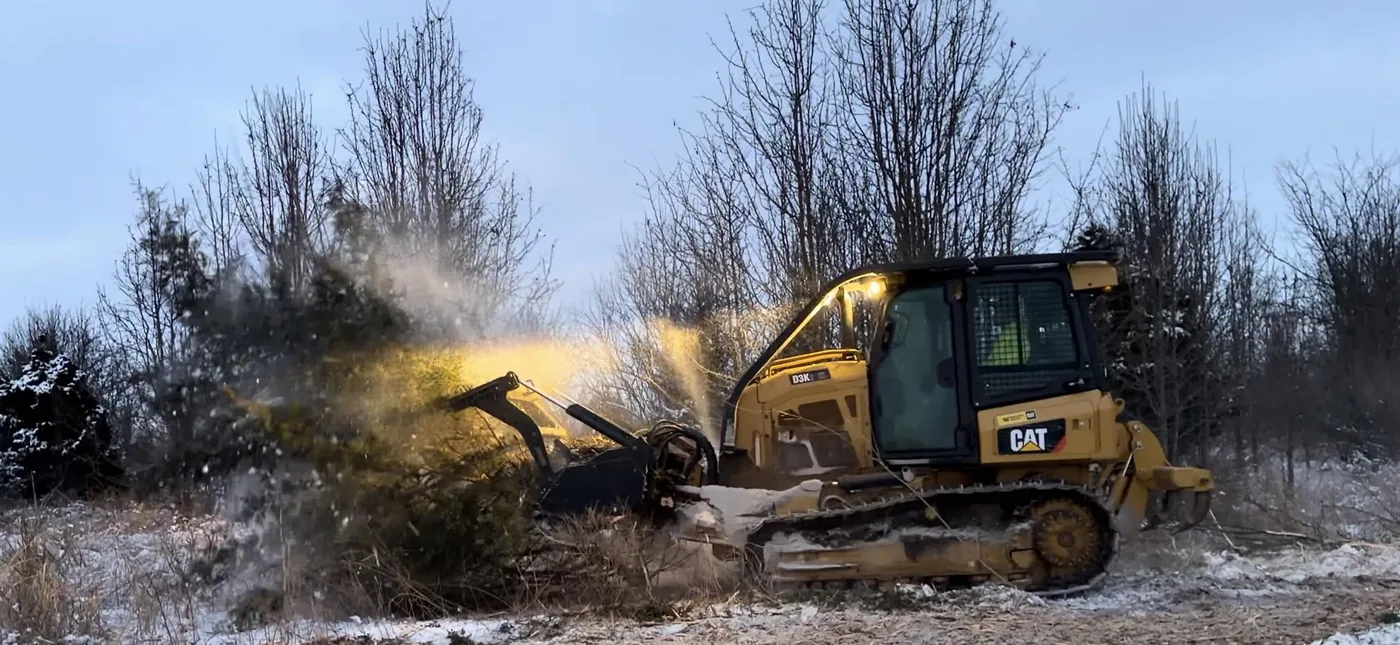
Forestry mulching uses a machine with a rotating mulching head to grind standing brush and small trees where they stand. The material drops to the ground as a layer of mulch, so there’s no burn pile, no stack of logs to haul, and no line of dump trucks going in and out of your property.
That mulch layer keeps working after the machine leaves. It helps hold soil in place through the first hard rains, keeps dust down, and breaks down into the ground over the next couple of seasons.
Mulching only grinds what’s above ground. The roots and stumps stay in place, which is the main difference between mulching and full land clearing, and a big part of the cost difference too.
The factors that move the price
How thick the growth is
Density matters more than acreage. Light brush and scattered saplings go several times faster than a solid stand of eastern red cedar or a thicket of bush honeysuckle. Those two plants are what’s filling in old pasture and the edges of wooded lots on a lot of Kentucky properties, and both get dense fast.
A one-acre lot packed with cedar can take longer than three acres of light brush. A per-acre price quoted over the phone usually doesn’t mean much until someone has seen the ground.
Stem size
Forestry mulchers are built for brush and small trees. On our jobs, the most efficient range is stems about 5 inches in diameter and under. The machines can handle bigger material, but past that size a grapple saw or an excavator is usually faster and cheaper.
If your property has a mix of brush and larger trees, the estimate may include more than one machine, and you should know which sections are mulcher work before the job starts.
Terrain and grade
Flat, firm ground lets a skid steer with a mulching head work quickly. Steep grades, creek banks and soft ground slow everything down and may call for a steel-tracked machine. Our steel-tracked dozer mulcher handles grades and soft ground where a skid steer can’t go. Steep or wet ground still means slower going, and that shows up in the price.
Access
How close can equipment get to the work, and what does it have to cross on the way? A fence line along a gravel drive is a different job from a back corner you can only reach by crossing a yard, a creek or a neighbor’s field. We look at gates, culverts, septic fields and soft spots during the walkthrough.
Distance from our base
Leading Edge runs out of Cox’s Creek in Nelson County. On an acreage job, the drive to Louisville or Shelbyville barely matters. On a small single-day job at the far end of our service area, it can.
Mulching or full clearing: the biggest cost decision
The method changes the price more than anything else. Mulching in place is the fastest and least expensive way to clear ground per acre, because nothing gets hauled off. Full clearing, sometimes called grub and haul, pulls out the trees, stumps and root systems and leaves clean dirt. It takes longer and costs more because of the extra machine time, trucking and disposal.
What you need depends on what the ground has to do next. For reclaiming pasture, opening trails, clearing fence lines or cutting sight lines, mulching is usually the right call. If you’re building a house or barn, pouring a pad, digging a pond or grading, the roots have to come out, so you need full land and lot clearing.
The costly mistake is mulching a site to save money and then finding out it has to be cleared again before a foundation or pond can go in. A decaying root system under a pad can cause settling years later. That’s why we ask what the ground is for before we price it.
Common mulching jobs around Louisville
Overgrown pasture
Pasture that hasn’t been grazed or cut for a few seasons fills in from the fence lines toward the middle. Mulching takes it back in one pass without pulling the root plate out of the field, so the ground stays firm enough to run stock or equipment on afterward. If the pasture is only lightly grown in, a tractor with a bush hog is often cheaper, and we’ll tell you so. Our brush and undergrowth mowing service covers that lighter work.
Fence lines
A neglected fence line will have saplings growing through the wire, and the fence can’t be repaired until it’s cleared. Mulching moves fast here and can leave good posts and wire in place. Where the growth is too big or has grown around the wire, that section comes out with the excavator.
Trails and access roads
Mulching cuts a trail and surfaces it in the same pass, so it’s drivable when the machine leaves. Hunting properties, paths to a future build site and logging access are common examples. We walk and flag the route and width first, because a trail in the wrong place is expensive to undo.
Understory and sight lines
Sometimes the mature trees are what you want to keep and the brush underneath is the problem. Selective mulching opens up the view, makes a wooded lot walkable and reduces the fuel load without touching the canopy. It’s slower, more careful work, since the machine has to work around every tree that stays.
What mulching won’t do
You should know the limits before you pay for the work. Mulching leaves roots and stumps in the ground, and some plants, bush honeysuckle among them, will resprout from what’s left. If you want a site to stay open long term, plan on follow-up mowing. If you want to treat regrowth, your county extension office can tell you what’s appropriate for the plants on your land.
Mulching also won’t give you a buildable site. If a building, pond or driveway is in the plan, say so up front.
Mulching and burn rules in Kentucky
One reason people choose mulching is that it avoids a burn pile, and in Kentucky that matters. State law sets two forest fire hazard seasons, February 15 through April 30 and October 1 through December 15, when burning within 150 feet of woodland or brushland isn’t allowed between 6 a.m. and 6 p.m. In Louisville and Jefferson County, open burning is restricted year-round under Louisville Metro Air Pollution Control District rules, and Bullitt County doesn’t allow burning of land clearing debris from May through September. Check with the Kentucky Division of Forestry or your local air agency before planning any burn.
How to get an estimate that holds up
We price mulching per job after walking it, with no rate card. Here’s how it works:
- Call us, then text your name, the property address and a few lines about what you want done.
- Walk the property with us. Being there helps, because that’s where boundaries get agreed on and flagged, and where we learn what the ground needs to do when we’re finished.
- Get a detailed written estimate, left with you before we leave.
Whether there’s a charge for the estimate depends on the job. Tell us what you have when you call, and you’ll know before anyone heads your way.
For planning, figure about an acre a day per machine. That number moves with how thick the growth is and how steep the ground gets, and the walkthrough is where you get a real number for your property.
Talk to our team
Leading Edge Tree Service has been in the trade since 2016 and handles forestry mulching, land clearing and excavation across the Louisville metro, including Jefferson, Bullitt, Nelson, Spencer, Shelby and Hardin counties. We’re insured and BBB accredited.
To set up a walkthrough, call (502) 296-2607. You can also read more about our forestry mulching service or the work we do in Louisville.